Articles
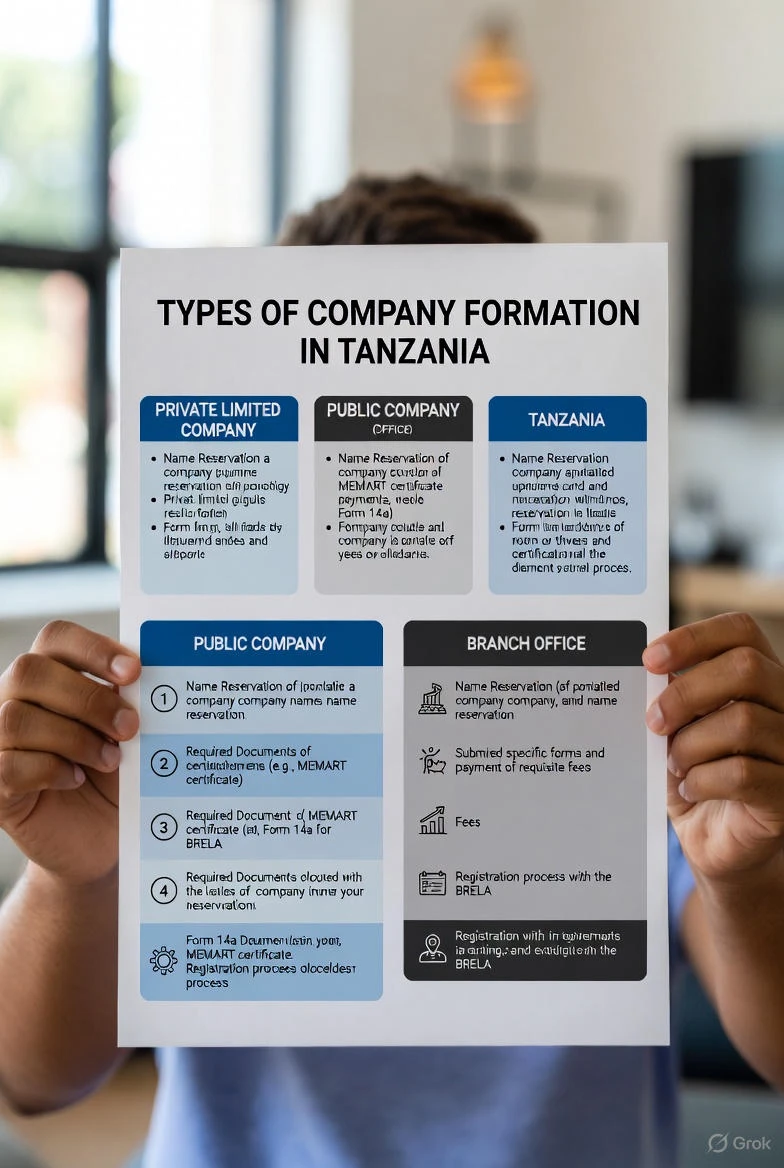
types of company formation in tanzania
Starting a business in East Africa is an exciting prospect, and the United Republic of Tanzania offers a dynamic, growing market ripe with investment opportunities.
However, navigating the legal landscape to establish your presence requires a clear understanding of the available types of company formation in Tanzania.
Whether you are a local entrepreneur or an international investor, choosing the right corporate structure is the foundational step for legal operation, effective taxation, and future growth.
This comprehensive guide will walk you through the primary types of company formation in Tanzania managed by the Business Registrations and Licensing Agency (BRELA), ensuring you select the optimal structure to launch your venture with confidence.
1. The Private Limited Company (LTD)
The Private Limited Company (LTD) is, by far, the most popular and versatile of the types of company formation in Tanzania, particularly among foreign and domestic investors.
Key Characteristics:
Limited Liability: The core benefit is that the financial liability of the shareholders is limited to the amount of shares they own. This separates the business's legal and financial obligations from the personal assets of the owners.
Share Structure: The company is owned by its shareholders through shares. It must have a minimum of two directors and two shareholders, though the roles can be held by the same individuals (who can be of any nationality).
Transfer of Shares: The articles of association restrict the free transfer of shares to the public, keeping the ownership private.
Perpetual Succession: The company exists as a separate legal entity, meaning its existence continues even if the shareholders or directors change.
Why Choose an LTD?
The LTD structure is ideal for medium to large-scale operations and any business that plans to raise capital, hire staff, or enter into significant commercial contracts. Most international businesses starting from scratch in the country opt for this among the types of company formation in Tanzania because it provides a clear, internationally recognized legal framework.
2. Branch or Foreign Subsidiary
For international companies already established outside of Tanzania, opening a Branch Office or a Foreign Subsidiary is a key consideration among the available types of company formation in Tanzania.
The Branch Office:
A Branch Office is essentially an extension of the parent company registered abroad.
Legal Status: It is not a separate legal entity. The liabilities and assets remain those of the foreign parent company.
Scope of Activity: Its activities are typically limited to those specified in the parent company’s charter.
Registration: The registration process involves submitting certified copies of the parent company’s constitutional documents (like the Memorandum and Articles of Association) and an official power of attorney authorizing a local representative.
The Foreign Subsidiary:
A Foreign Subsidiary, while often fully owned by the parent company, is registered in Tanzania as a Private Limited Company (LTD).
Legal Status: Crucially, it is a separate legal entity from the parent company. This means it carries its own liabilities and benefits from the legal protections of a local Tanzanian company.
Compliance: It must comply fully with all Tanzanian company law and tax regulations, just like a locally owned LTD.
Choosing Between Them:
Most international experts recommend the Foreign Subsidiary (registered as an LTD) for long-term, significant investments, as it limits the parent company's liability. The Branch Office is usually reserved for shorter-term projects or liaison activities. Navigating the registration for either of these types of company formation in Tanzania requires specialized knowledge.
3. Sole Proprietorship and Partnerships
These types of company formation in Tanzania are simpler, generally reserved for smaller businesses and local operations.
Sole Proprietorship:
Ownership: Owned and run by one person, who is personally responsible for all business debts.
Simplicity: Registration is straightforward, often involving only obtaining a business name and relevant licenses.
Liability: There is no separation between the business and the owner; hence, liability is unlimited.
Partnerships:
Structure: An arrangement between two or more parties (individuals or companies) who agree to share in the profits or losses of a business.
Liability: In a general partnership, all partners share equal and unlimited liability. A Limited Partnership (LP) may be possible to offer limited liability to specific partners.
Agreement: Requires a detailed partnership deed outlining roles, profit-sharing, and dispute resolution.
4. Investment Company Registered with TIC
Investors planning large-scale projects that meet certain capital thresholds may qualify for registration with the Tanzania Investment Centre (TIC). This is not a legal structure itself, but a special designation that offers significant incentives.
Incentives: Registration with TIC can lead to access to investment guarantees, simplified procedures, and various tax and duty incentives, making this an important path for specific types of company formation in Tanzania.
Requirements: A business must typically be registered as a local company (LTD) first and then apply for a TIC Certificate of Incentives, meeting specific minimum investment requirements.
Simplified Path to Compliance and Launch
Selecting the appropriate structure from the various types of company formation in Tanzania is only the first step. The process requires meticulous coordination for document preparation, submission to BRELA, securing a Tax Identification Number (TIN), VAT registration, and obtaining specific business licenses for your sector (Commercial, Industrial, Agricultural, Mining, etc.).
A successful launch requires professional guidance that spans the entire spectrum, including:
Company Formation Services in Tanzania: Handling the entire registration process from start to finish.
Business Licensing: Securing all necessary permits with bodies like TRA, NSSF, and sectoral ministries.
Accounting & Taxation: Ensuring ongoing compliance with local financial regulations.
Legal Advisory Services: Providing full legal protection and contract review.
Launch Your Business with Confidence
The journey through the official types of company formation in Tanzania should be a streamlined and confident process, not a barrier. City Squares provides international expertise and professional management, ensuring your corporate setup is robust, compliant, and poised for growth.
We simplify every step, from initial registration to post-incorporation support, allowing you to focus on your core business.
To discuss which of the types of company formation in Tanzania is best suited for your investment and to start your company launch today, you can reach out to our professional team:
📞 Get Expert Advice Now:
Launch your business with confidence... with City Squares – International expertise & professional management:
Discuss your setup via WhatsApp:
Click Here to WhatsApp (All services handled without mention of price or cost; simply contact us to discuss your needs).Explore our comprehensive Company Formation Services in Tanzania:
City Squares Company Formation Book an Appointment:
Schedule Your Consultation Learn More About Us:
City Squares About Us Need Saudi Embassy Services in Tanzania?
View Services Logistics & Customs?
Sea Freight, Customs Clearance, Cargo Transport & Warehousing Recruitment Needs?
Recruitment Services from Tanzania to the World
Launch your business with confidence… with City Squares – International expertise & professional management

Company Formation Services in Tanzania

Guide to Establishing a Private Limited Company in Tanzania

Branch or Foreign Subsidiary in Tanzania

Partnerships and Sole Proprietorships in Tanzania Guide

Investment Companies (TIC) in Tanzania
Latest Posts



Ready to start your project? Request your service and begin your journey with us!

International Expert Mohammed bin Rashid bin Adwan